
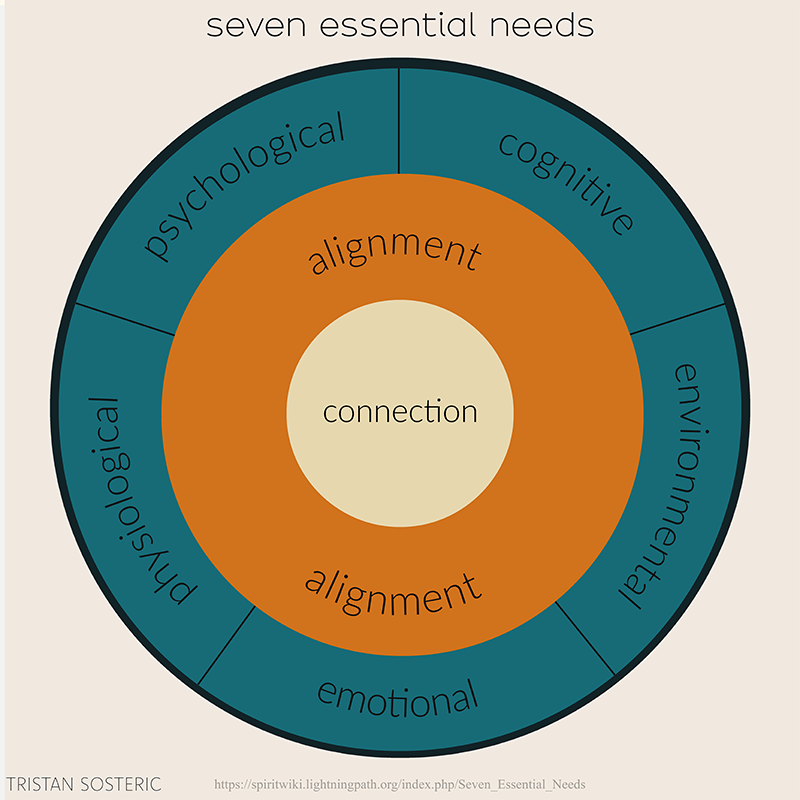
One of the Seven Essential Needs outlined in the Theory of Essential Needs (Sosteric, 2016) is alignment. As outlined in my article “Eupsychian Theory I,” the seven essential needs are just that, essential. They are the physiological, environmental, cognitive, emotional, psychological, alignment, and connection needs that are fundamental requirements of human health and full development (Sosteric, 2016; Sosteric & Ratkovic, 2022). Five of them are outer or basic needs. Two are inner needs, and alignment is the first of these.
What Is Alignment?
In LP theory, Alignment is the need to live in agreement with your own deepest nature, your inner self, your values, your ethics, and your purpose. In the formal statement of the theory, Inner Alignment refers to “cognitive, emotional, and behavioural alignment with one’s inner self,” while Outer Alignment refers to our equally real need to align with “family, community, traditions, ancestors” — to fit in with, and genuinely express, the values of the groups we belong to (Sosteric & Ratkovic, 2022, p. 121).
In a bit more detail:
- alignment with the inner self — thinking, feeling, and acting in a way that is true to who you actually are; alignment with the Being-Values of the inner self, truth, compassion, justice, and so on, which people choose naturally when they are given “good conditions for choosing”; and
- alignment with one’s family, community, and ancestors, and with ethical and moral systems of Right Thought and Right Action.
In Lightning Path terms, alignment means syncing up the Bodily Ego with the Spiritual Ego — with that “very bright, powerful, kind, compassionate, loving, and aware spiritual being” that constitutes your highest self (Sosteric, n.d.). If you want a concrete picture of what an aligned person looks like, think of figures like the Buddha or Jesus, people whose outer conduct visibly expressed their inner being and truth (Sosteric, n.d.).
Alignment is a deliberate, and important, renaming of what humanistic psychology called self-actualization. Maslow (1943) defined self-actualization with his famous line: “A musician must make music, an artist must paint, a poet must write, if he is to be ultimately happy. What a man can be, he must be. This need we may call self-actualization” (p. 382). The insight was right, but the term is culturally loaded: it elevates a Western, individualist, capitalist-friendly image of the high-performing “self” over more relational, collectivist ways of being. “Alignment” says the same thing in culturally neutral language, and it extends the idea outward. You are not aligned when you merely perform your individuality; you are aligned when your inner life, your conduct, and your communities are in agreement (Sosteric, 2026; Sosteric & Ratkovic, 2022).
Why Alignment Is a Critical Need
Alignment is not a “nice-thing-to-if-you-can-manage-it” sort of thing. In the Theory of Essential Needs, all seven needs are exactly that, essential. If any need goes unmet, growth slows, health is undermined, and the body’s energies are away from growth into defence, repair, and escape (Sosteric, 2026). Chronic unmet needs lead, over time, to disconnection, diminishment, dysfunction, disease, and premature death — the “5Ds of Toxic Existence.” An unmet need for alignment specifically leads to anxiety, despair, depression, self-loathing, and in the most severe cases, self-destructive behaviours.
In addition, alignment specifically sits on the inner pathway to connection, the seventh need at the core of the circle. You cannot establish deep, authentic connection, to others, to nature, to something larger than yourself, while living a life that betrays your own values. There is a psychological/political edge to this: people whose needs go chronically unmet carry a lifelong craving that makes them easier to manipulate, because manipulators of every stripe, employers, marketers, cult leaders, know how to promise the satisfaction of needs they never intend to meet. An aligned person, rooted in their own values, is far harder to lead around by the nose.
This Is Not a New Idea
The concept of alignment might seem new to you, but it’s not. Humans have been talking about this need for centuries. Every serious tradition of thought about human flourishing, religious, humanist, socialist, utopian, has a word for it. They describe the same need in different vocabularies. Consider the following.
Karl Marx — “species-being.” Long before Maslow, the young Marx argued that human beings have an essential nature from which a badly organized society alienates them. “The whole character of a species — its species character — is contained in the character of its life-activity; and free, conscious activity is man’s species character,” he wrote in the Economic and Philosophic Manuscripts of 1844, noting that the human being “produces even when he is free from physical need and only truly produces in freedom therefrom” (Marx, 1844/1978). Alienated labour, in his account, tears people away from this species-life, from who you are inside and from the creative and productive expression of that nature. When this happens, you become alienated from your own self, from your species being, miserable, and sick. You become a shadow of who and what you could be.
Erich Fromm — “spontaneous activity” and “giving birth to yourself.” Fromm, a much underappreciated psychologist operating during the last part of 20th century, spent a career circling this need. In Escape from Freedom he wrote that “spontaneous activity is the one way in which man can overcome the terror of aloneness without sacrificing the integrity of his self; for in the spontaneous realization of the self man unites himself anew with the world — with man, nature, and himself” (Fromm, 1941, p. 287). In Man for Himself: “Man’s main task in life is to give birth to himself, to become what he potentially is” (Fromm, 1947, ch. 4). In The Sane Society, he grounded it in human nature itself: “Just as the infant is born with all human potentialities which are to develop under favorable social and cultural conditions, so the human race, in the process of history, develops into what it potentially is” (Fromm, 1955, p. 14). And in To Have or to Be, he described the mode of existence in which one “neither has anything nor craves to have something, but is joyous, employs one’s faculties productively, is oned to the world” (Fromm, 1976, pp. 18–19).
Edward Bellamy — “natural aptitude.” In the utopia of Looking Backward, the entire labour system is built around alignment by another name: “Every man for himself in accordance with his natural aptitude, the utmost pains being taken to enable him to find out what his natural aptitude really is” (Bellamy, 1888, pp. 39–40). A man’s natural endowments, Dr. Leete explains, determine what he can work at “most profitably to the nation and most satisfactorily to himself” (Bellamy, 1888, p. 39).
William Morris — “pleasure in the work itself.” For Morris, aligned work is creation: “A man at work, making something which he feels will exist because he is working at it and wills it, is exercising the energies of his mind and soul as well as of his body” (Morris, 1884/1986, pp. 117–118). In News from Nowhere, Hammond dismisses the very idea of external reward: “‘No reward of labour?’ said Hammond gravely. ‘The reward of labour is life. Is that not enough?’ … ‘Plenty of reward,’ said he — ‘the reward of creation. The wages which God gets, as people might have said time agone'” (Morris, 1890/1993, p. 261).
B. F. Skinner — “doing what you are best qualified to do.” Even the arch-behaviourist saw it. Reflecting on Walden Two, Skinner asked: “How many Americans can say that they are doing the kinds of things they are best qualified to do and most enjoy doing? What opportunities have they had to choose fields related to their talents or to the interests and skills they acquired in early life?” (Skinner, 1976, p. xii).
Erik Olin Wright — “human flourishing.” The contemporary sociologist of “real utopias” makes it the yardstick of a just society: “The expansive idea of flourishing refers to the various ways in which people are able to develop and exercise their talents and capacities, or, to use another expression, to realize their individual potentials” (Wright, 2010, pp. 8–9).
It is not only scholars that speak of this notion of alignment. You also find it in the religious corpus of every major religion, something we deal with in a companion article.
Conclusions
Species-being, who you are inside, your true self and the spontaneous activity, natural aptitude, and rewards (feeling good about yourself, etc.), and the need for alignment to that inner being are constant human themes. The vocabulary changes across two centuries, but the underlying claim does not: human beings have an inner nature and real capacities. Health means living in agreement with them and developing your ability to express them. Human flourishing requires development of inner capacity in all beings. The need for alignment is not an invention; it is one of the oldest observations our species has made about itself. What the Theory of Essential Needs adds is precision and placement: alignment is a need, like food or safety, and like all the essential needs it cannot be met in isolation. It takes good conditions and, in the end, a society actually geared toward meeting all of them.
References
Bellamy, E. (1888). Looking backward 2000–1887.
Fromm, E. (1941). Escape from freedom. Farrar & Rinehart.
Fromm, E. (1947). Man for himself: An inquiry into the psychology of ethics. Rinehart.
Fromm, E. (1955). The sane society. Rinehart.
Fromm, E. (1976). To have or to be? Harper & Row.
Harvey, D. (2000). Spaces of hope. University of California Press.
Marx, K. (1967). Capital: A critique of political economy (Vol. 3). International Publishers. (Original work published 1894)
Marx, K. (1978). Economic and philosophic manuscripts of 1844. In R. C. Tucker (Ed.), The Marx-Engels reader (2nd ed.). W. W. Norton. (Original work written 1844)
Maslow, A. H. (1943). A theory of human motivation. Psychological Review, 50(4), 370–396. https://doi.org/10.1037/h0054346
Morris, W. (1986). Useful work versus useless toil. In News from nowhere and selected writings and designs. Penguin. (Original work published 1884)
Morris, W. (1993). News from nowhere. In News from nowhere and selected writings and designs. Penguin. (Original work published 1890)
Skinner, B. F. (1976). Walden two. Hackett. (Original work published 1948)
Sosteric, M. (n.d.). Seven essential needs. In The SpiritWiki. Retrieved August 18, 2026, from https://spiritwiki.lightningpath.org/index.php/Seven_Essential_Needs
Sosteric, M. (2026). Rocket scientists’ guide to money and the economy: Utopia Education Lightning Path Press.
Sosteric, M. (2026). Eupsychian theory I: Reclaiming Maslow and rejecting the pyramid — The circle of seven essential needs. Athens Journal of Psychology, 2, 1–26. https://doi.org/10.30958/ajpsy.2-1-1
Sosteric, M., & Ratkovic, G. (2022). It takes a village: Advancing attachment theory and recovering the roots of human health with the circle of seven essential needs. Aotearoa New Zealand Social Work, 34(1), 113–127. https://doi.org/10.11157/anzswj-vol34iss1id887
Wright, E. O. (2010). Envisioning real utopias. Verso.