
Here is the story.
My family and I have homed eight feral cats–six of them trapped in our back yard—from kittens to full grown adult. Despite the things I have heard about how it is impossible to domesticate a feral adult, they’re all trusting members of the family now. They demand my attention, they cuddle up, they sleep soundly in my arms, on my lap, or beside me on the bed.
It wasn’t always this way.
When we first trapped them they didn’t want to have anything to do with us. In fact, they stayed as far away as they could manage. Willy-Feral, our second feral, hid in the furnace ducts underneath the basement floor for months. We had to trap him three times to get him out of there. Keanu, our most recent, when we finally released him from quarantine, bit me so hard when I tried to grab him that I’m convinced he left a piece of his tooth still in my finger. Now, both of those male toms fight for my attention and space on the soft blankets I place on my desk. Willy sleeps cuddled up with me in bed, as does Keanu. Keanu loves to kiss me. He likes to hold my hand. I am regularly woken up in the middle of the night to his loud purring and aggressive head butting. Even Sam, our long-time reluctant Siamese, now regularly invites touch. It’s remarkable.
Having domesticated eight feral cats, I’ve noticed some things over years.
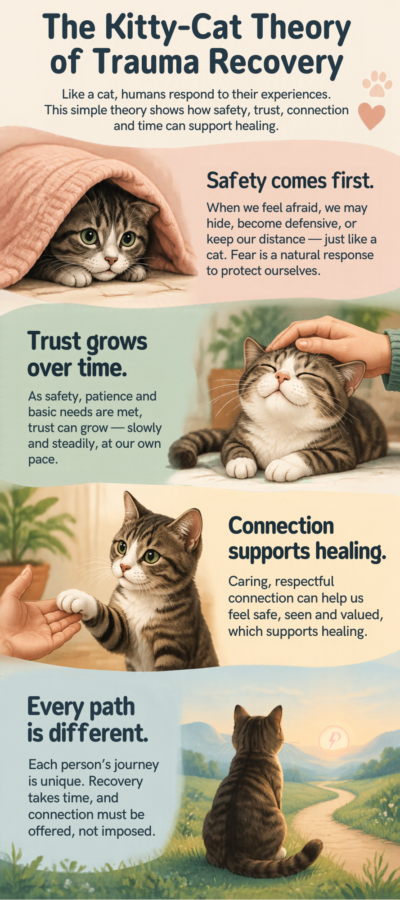
Number one, when they first come into the house, they don’t trust you and they don’t want to be around you. When we captured Willie he tried to jump out our windows with such force I was afraid he’d break his neck. He hid for months downstairs. Keanu tried to bite my fingers off. He also found dark corners of the house to hide in. Sam was the same. Rags too. Chang was a weird case which maybe I’ll talk about later. The point here, when they first come, they’re scared of the dangerous humans and so they hide themselves away.
Number two, they are reactive and defensive. They growl at you so you know to stay away. They swipe at you, claws out, if you get too close. They do not trust you. They treat you as a threat.
Number three, if you just leave them alone trust builds up over time and they eventually enter the family fold. Over time, rather than completely avoiding you, they gradually become OK being around you. It’s a gradual process, most often led by food and cat treats. When we thought he was ready, we brought Willie’s food and water upstairs and put it in our room. We put a cat box in the bathroom, fed him under the bed, and left him alone. One day, a switch flipped in his brain. He jumped on the bed, plopped himself down, and slept for two days. I remember thinking it must be exhausting being on high alert all the time.
Keanu was the same, hiding under our beds. His shift to trust and not fear occurred when I stepped on his toes in the middle of the night while he was walking in the hallway. His foot was bleeding and in pain. My daughter and I had to drag him out from under the bed and take him to the vet. When he came back all fixed up, there was an immediate change in attitude. Suddenly, he trusted me. He went from dweller-under-the-bed to loving feline overnight. I believe he understood what I had done, that this convinced him I could be trusted, and that he is grateful for the help. Even so, I’m still really the only one he completely trusts. I am the only one in our household of 4+ that can approach him without invoking his fear response. This is changing. He’s been slowly warming up to others. But it is slow and it requires effort, which brings me to point four.
Number Four, integration requires attention, effort, and care. At a certain point, once a basic trust has been established, the human has to do the work. Approach the cat slowly, pet them if available, feed them water and food, respond immediately with attention and love when the cat does approach.
Number five, each cat has its own path. Chang for example became a family member almost instantly. Sam took a lot longer than everybody else. She started off hiding. After a few months she’d hang out in the same room, but she didn’t like us to touch her or even be too close. Space was her thing. She really only trusted Titus Andromeda, our black cat. Then something shifted. Now she’s quite affectionate, even demanding. She also competes for desk-time. She’s sitting there right now eyeing the space as I type.
So what does this have to do with trauma in humans? My focus here is on fear. Cats have an amygdala that is similar to that of humans. The amygdala helps the body understand, process, and respond to threat. When you are afraid of something, you avoid it; you get as far away from it as you can. This fear can be triggered instinctively, as it is cats, animals, and humans, but it can clearly be modified by experience. It can also be learned. Humans learn feral forms of avoidance particularly as they experience chronic trauma and abuse, as so many do, especially as children and adolescents, and always during key developmental periods when children are small, weak, vulnerable and susceptible. Within the Toxic Socialization systems of our modern world, many of us learn to avoid in one way or another; some more, some less. Some manage. Others stay as far away from human contact as possible, only approaching when, and if, they feel safe. Like cats, they will hide away, gradually coming out as they gradually learn to trust. Over time, if the environment is safe, they may enter the family fold. But, it takes time and, most importantly, safety. As long as the cat, or the human, feels unsafe, it’s going to withdraw. It is only as it begins to feel safe that it will gradually, tentatively, emerge. This emergence is not the entire healing journey, but it’s a step in the right direction.
Which brings us to the kitty-cat theory of trauma recovery. Healing trauma, specifically the internalized fear of other that prevents contact and connection, requires, at base, time, patience, a safe environment, food, water, and always an occasional treat. In other words, safety and basic needs satisfaction. This isn’t quite enough, though, for cats no less than for humans. It is just the start. Willie didn’t domesticate in the basement. He domesticated when he came upstairs, into the room with us, and stayed. Keanu didn’t stop fearing me because the house was quiet; he stopped because I carried him to the vet and brought him back whole. In every case, the turning point wasn’t solitude, it was contact and connection. The literature on humans says exactly this. Judith Herman’s foundational work on trauma is blunt: recovery “can take place only within the context of relationships; it cannot occur in isolation” (Herman, 1992). Porges’ polyvagal research points to one of the mechanisms, co-regulation. A calm nervous system nearby literally downregulates a threatened one (Porges, 2022). It is more than just that though. Humans are, by their very nature, relational. It is their relationship to things, people, food, the natural world, etc., that is what defines them and make them whole. The initial path of healing requires making space for healthy relations to emerge. Conceptually, it’s not rocket science. With a little care, attention, and support, they emerge naturally. Practically, of course, it takes time and effort.
Important point: the relationship has to be offered, not imposed: trauma robs its victims of power and control, and “the guiding principle of recovery is to restore power and control” (Herman, 1992). You don’t drag the cat out from under the bed unless there is a medical issue. You sit in the room, nearby and undemanding, and let it come to you. Quiet safety gets them out of the basement. Presence gets them into your space. Food, water, an occasional treat, and someone who isn’t going to hurt them, brings them into the fold.
References
Herman, J. L. (1992). Trauma and Recovery: The Aftermath of Violence—from Domestic Abuse to Political Terror. Basic Books.
Porges, S. W. (2022). Polyvagal theory: A science of safety. Frontiers in Integrative Neuroscience, 16, 871227.