
Everybody knows Marx’s famous term “the means of production.” People who are afraid of communism use it as a bugbear as in “communists are going to nationalize the means of production and then you won’t be able to own your own home.” That’s not true, of course. The means of production are not personal property like your house, car, or phone; they are the factories, the land, the machines, and all the things you need to manufacture and distribute stuff, like phones or even useless plastic bobbles at scale. Marx said these means mattered because the people who owned them had enormous power and control over everybody’s lives. That’s certainly true, but that’s a topic for another day.
Fewer people know that Marx had a companion term, the Means of Mental Production (MOMP). The MOMP are the factories and machines of the mind, the institutions and objects through which a society’s ideas are manufactured and distributed. If the means of material production determine who makes your goods, the means of mental production determine who makes your ideas.
Historically, the MOMP meant the church, the school, the university, the printing press, the newspaper, the radio station, the film studio. Today the list has grown to include the television networks, the publishing houses, the cable systems, the news sites, and the distribution platforms: YouTube, Facebook, Instagram, TikTok, X. Notably, the list now also includes the search pipelines through which we access the global Internet and the AI systems being trained on everything the rest of the list ever produced.
In The German Ideology, Marx observed that “the class which has the means of material production at its disposal, has control at the same time over the Means of Mental Production, so that thereby, generally speaking, the ideas of those who lack the Means of Mental Production are subject to it” (Marx, 1947, p. 39). What Marx is basically saying here is that the people who own the MOMP control not only the ideas that are produced but the ideas that are distributed as well. Practically this means that in every era, the dominant ideas of a society flow through a manageable handful of institutions owned by members of what Marx called the ruling class but what I call the Accumulating Class,1 the social class that accumulates wealth and power. The accumulating class owns and controls the means of mental production. The pulpit belonged to the church. The newspaper belonged to the publisher. The feed belongs to the platform. This raises some important questions.
The Means of Mental Production have always been concentrated in a few hands, but that concentration has gotten worse over the years. In 1983, 90 percent of the American media was owned by fifty companies. Today the same 90 percent is controlled by six mega-corporations, presiding over a combined half-trillion dollars in media assets (Levy, 2026; Lutz, 2012).
Drill down, and it gets worse.
Local television, still the primary news source for most Americans, is dominated by a handful of station groups. Nexstar, the largest, owns 265 stations in 132 markets reaching roughly 79 percent of U.S. television households; Sinclair, number two, owns 185 stations reaching about 38 percent of the country (Nexstar Media Group, n.d.).
In newspapers, hedge funds and private equity firms now own roughly half of all daily newspaper circulation in the United States, and the three biggest chains alone control more than half of it, a collapse so thorough that researchers at UNC now map what they call “news deserts”: places with no local newspaper, or only one (UNC Center for Innovation & Sustainability in Local Media, n.d.).
In radio, iHeartMedia owns 855 stations, reaches over 110 million listeners a week, and bills itself as “the largest reach of any radio or television outlet in America” (iHeartMedia, n.d.; Wikipedia, 2026). At the movies, the five remaining film studios command about 90 percent of the box office.
And then there is social media, the global town square where everybody now goes to talk. Some 84 percent of American adults use YouTube, 71 percent use Facebook, half use Instagram, 37 percent use TikTok, and 21 percent use X, maybe. Who can tell with all the bots; by one recent estimate, those five platforms absorb on the order of 80 percent of all the time Americans spend on social media (Buckweitz & Noam, 2024; Pew Research Center, 2025).
Who owns and controls the square where the ideas flow?
Four men. Mark Zuckerberg’s dual-class shares let him rule Facebook and Instagram personally, whatever public shareholders think. TikTok’s American business is now controlled by a consortium led by Larry Ellison’s Oracle (TechCrunch, 2026). Elon Musk bought Twitter for $44 billion, took it private, and now has complete control over the algorithms that surface tweets — the closest thing the world had to a public utility for collective speech is one man’s property (Mann et al., 2025). Zuckerberg, Ellison, Zhang, Musk: four people, most of the country’s social attention, and supervoting shares making each of them answerable to no one.
Finally, and most disturbingly, there is the search pipeline, the gateway to virtually everything we know. The Global Media and Internet Concentration Project, a thirty-eight-country scholarly collaboration based at Carleton University, found that search is effectively a duopoly (Buckweitz & Noam, 2024). Remarkably, Google controls 91 percent of the GLOBAL search market. Ideas all flow through Google (Statcounter, 2026). That’s a remarkably Orwellian statistic. If it doesn’t scare the shit out of you, at least pause and consider it next time you type words into a search bar. Who makes the decisions on what words get returned, and on what grounds are these made?
Marx had an answer for that. Marx said the ruling class made those decisions and the Conceptive Ideologists produced and distributed them (Marx & Engels, 1845/1978). Conceptive ideologists are the individuals who work within and operate the Means of Mental Production. They are the writers who write the scripts, the books, the songs, the videos, and the movies; the journalists who write the stories and choose the angles (“if it bleeds it leads”); the anchors who read the copy; the professors who write the syllabi and the textbooks; the editors who decide what gets published and what does not; the algorithm engineers who decide what gets surfaced and what stays invisible. The content cops who take down offending materials. Most of them are not scheming propagandists. They are ordinary people doing ordinary jobs inside what they feel are institutions. They are ideological soldiers doing what they are told.
We can see the operations of these institutions clearly. In 2012, Jeff Bezos bought the hugely influential Washington Post with his personal money. February 2025, he announced that the paper’s opinion pages would henceforth write “every day in support and defense of two pillars: personal liberties and free markets,” adding that “viewpoints opposing those pillars will be left to be published by others.” This was a complete restriction on what opinions would be published in this hugely influential paper. The paper’s opinion editor resigned rather than implement it (Blodget, 2012; NBC News, 2025), but that’s OK. There’s always somebody else who needs a paycheck. There’s always somebody with a family that needs to eat. Under those conditions, you learn to see things a certain way, or you don’t eat.
You can also see the operation of these mechanisms by considering Sinclair Broadcasting. Sinclair Broadcasting doesn’t just own stations; it writes the news. The company produces corporate “must-run” scripts that its local anchors are required to read, word for word, as if they were local journalism. These scripts are dutifully read by the reporters that work for the giant, dozens of different anchors in dozens of different cities reciting identical text with identical intonation (The Conversation, 2018). You can watch the disturbing video yourself (Deadspin, 2018).
This is a remarkable example of how the owners of the MOMP distribute the ideas they want. Efficient, effective, and disturbing. The ideas in that video were written in a corporate office by conceptive ideologists, writers, and then distributed by journalists who all needed a paycheck.
Consider the film studios. Researchers using freedom of information requests have documented that the Pentagon’s Entertainment Liaison Office reads the scripts of American war movies and refuses access to personnel, equipment, and bases for any production that portrays the military in ways the brass dislikes. This is direct editorial control exercised over more than 2,500 films and television shows (Stimpson, 2025). The studios happily comply because jet planes and tanks are expensive and you can’t really access those at Hollywood scale outside of military spaces.
Your ideas of the American military are shaped directly by the men who run that show.
As an educator and author, I have several direct experiences of this. In 2016 I published an article on suicide in The Conversation. During the editing process, I was presented with two or three different perspectives and steered toward the one the editor favoured. It was very clear to me that if I had not chosen the perspective the editor preferred, I would not have been invited to publish the article. I wanted to discuss what they wanted to discuss, so I did not compromise, but if I had come in with a different perspective, and if I refused to alter my stance, it was clear my article would never have appeared.
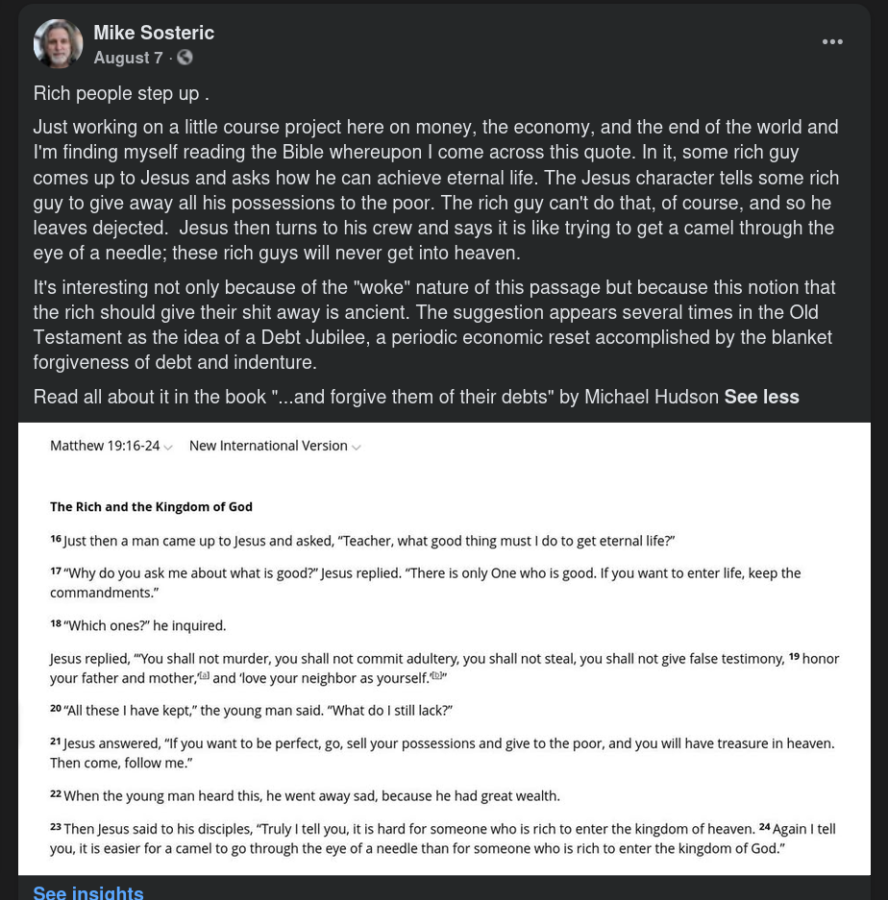
Or consider this recent experience of mine. I posted the following on my Facebook feed. It’s a research note pointing out how, while I was reading the Bible, I noticed how Jesus didn’t really like rich people. I pointed out this was very “woke” of him and then said that this sort of anti-rich antagonism appears elsewhere in the bible as well. It was pulled and my profile was “limited.” The reason, copyright violation. I shared somebody else’s intellectual property. Of course I didn’t. I quoted the Bible which is public domain, but that’s just the excuse. And what am I going to do about it? Facebook is not regulated. They don’t give care about my 50 follower account is banned. I either stop sharing ideas they do not want me to share, or I’m out. It is as simple as that.
And don’t get me started here on the scholarly communication process. Almost all the scholarly journals, and certainly all of them of note, are owned by powerful private companies like Springer and Elsevier. They control things. They issue orders. They gatekeep ideas.
Of course, “they” do not have total control. They never have. Every means of mental production in history—the pulpit, the press, the broadcast tower, the social media platform—leaks and is contested. People think what they are not supposed to think, write what they are not supposed to write, say it in ways the owners cannot predict and the algorithms cannot catch. Maintaining control is a constant struggle for the accumulating class, and that struggle is exactly where the battle over ideas is joined.
Recently, a growing number of prominent Washington journalists are leaving corporate publications to launch independent media outlets and digital startups. Notable ventures include The Washington Sun, alongside individual subscriber-supported platforms like The Contrarian, whose tagline is “Not Owned by Anybody.” Former DCist staff also launched The 51st to preserve local community reporting. Whether any of these offer real alternative ideas or not is an open question; the point here is, it’s possible to fight.
The battle is about getting new ideas out.
The weapons are the mouse and the keyboard and the screen.
The soldiers are you.
So take a minute not to just like and subscribe, but to repost. Don’t let the “algorithm” have total control. Manipulate it. Better yet, be a writer, a producer, a director, even an influencer, but share something new. Don’t work for the accumulating class. Don’t wiggle your young body for views or produce silly fluffy little pieces that distract. Don’t be stupid for the camera. Do something real. Do something substantive. Better yet, be what Marx called a conceptive ideologist. Find ways to take control, produce, and distribute different ideas. Are you a lawyer? Make new laws that regulate and control. Are you a tech-guru? Build a new platform, or revive an old one. Are you a worker? Organize your shop. Better yet, build counter institutions like new schools, new media organizations, etc. Take control of the means, not just the message.
You’re smart.
You can do it.
Just do it quick because honestly, we’re out of time. If the rich and powerful stay in control of ideas, that planet and its people are doomed.
But don’t take my word for it.
The Institute and Faculty of Actuaries recently published a frightening report entitled “Planetary solvency – finding our balance with nature.”2 An actuary is an insurance industry professional trained to measure, price, and manage risk and uncertainty using mathematics, statistics, financial models, and economics. “Planetary solvency” means the planet’s ability to carry human life. These are not hippies. These are not radicals. They are not “woke” in any sense of that world. These are the people who calculate whether your pension will be there when you retire. They are saying the planet may already be insolvent, that we have breached Earth’s operating limits, that tipping points are not hypotheticals but dominoes beginning to fall, and that, on our current path, catastrophic, cascading collapse is “eminently plausible.”Their risk matrix reserves its highest rating, ‘Extreme,’ for scenarios involving more than 4 billion deaths. That’s a lot, but even that just tip. Underneath all that is an indeterminate amount of human suffering, the heat deaths, starvation, dehydration, the wars over water, resources, and migration that are already here and will only get worse. if we don’t change our ideas now.
To be notified when new articles are published, or for daily conceptual shift, join our mailing list.