The Formation of the Bodily Ego: The Circle of Self
From Proposition to Mechanism
The foundational theoretical statements tells us that the bodily ego is a biologically instantiated consciousness, that it requires the satisfaction of Seven Essential Needs throughout the lifespan, and that it operates in Growth, Deficit, or Defense Mode depending on whether those needs are met. These propositions describe what the bodily ego requires and what happens when those requirements are violated. They do not yet describe how the bodily ego comes to be the particular self it is, its personality, the constituent abilities, aspirations, wounds, and limits. That is the work of the Circle of Self.
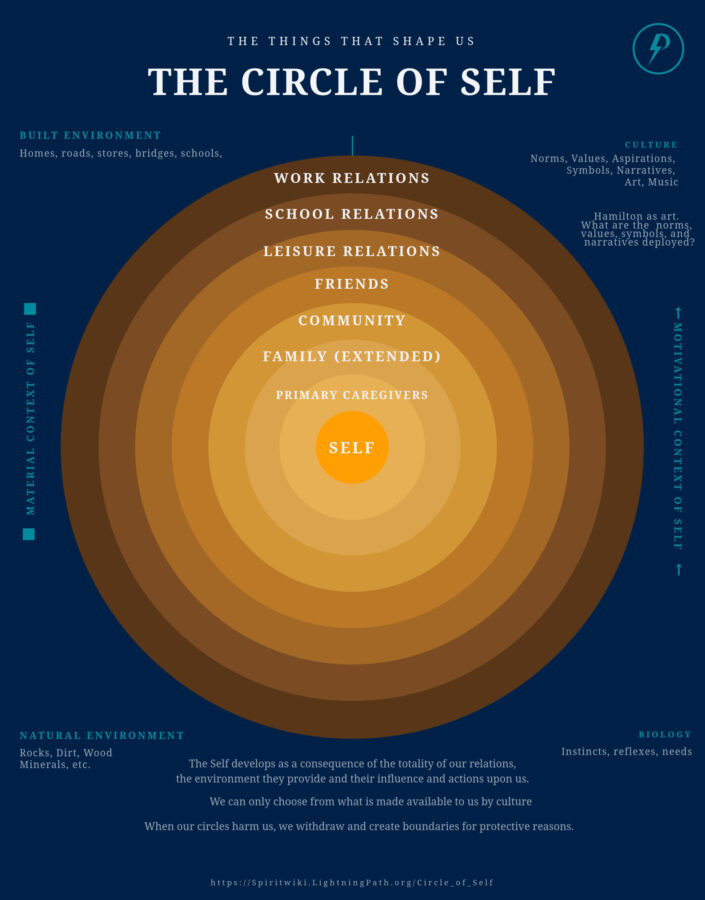
The Circle of Self is a theory of self formation. Its central claim is simple: there is no self outside of relations. The bodily ego develops as a consequence of the totality of its relations, the environment those relations provide, and their influence and actions upon it. The self is not born; it is built — ring by ring, relation by relation.
What Exists at the Beginning
At the beginning of life, there is no bodily ego at all. There is only the Material Context of Self, i.e., its Enabling Context a physical body equipped with instincts, reflexes, and needs; a natural environment; and a built environment — the homes, roads, stores, bridges, and schools into which the body arrives. The bodily ego develops after this material context, not before it, and always within it. Whatever the self later becomes, it builds from these raw materials and within these constraints.
Push and Pull: The Motivational Context
Movement through the circles of relation is driven by two intersecting forces. The first is a biologically rooted push — the instincts, reflexes, and needs that animate the body from within. This is the push side of the motivational engine described in the foundational propositions: the drive to get Seven Essential Needs met. The second is a culturally rooted pull — the norms, values, aspirations, symbols, narratives, art, and music a culture deploys, which reach into the developing self from outside and give it direction. The bodily ego is pushed by biology and pulled by culture, simultaneously, from its first day.
The Rings of Formation
Relations act on the developing self in a roughly temporal sequence: primary caregivers first, then extended family, then community, friends, leisure relations, school relations, and finally work relations. Each ring lays the foundation for the next. A self whose earliest rings are secure meets the school and the workplace from a position of strength; a self whose earliest rings are harmful meets them already armoured, withdrawn, or braced for attack.
This sequence explains why the foundational theory places such weight on early experience. The first rings are not merely influential; they are foundational. They establish the bodily ego’s default expectations about whether the world is safe or dangerous, whether others can be trusted, and whether its own needs will be met — the very expectations that determine, per the foundational propositions, whether it settles into Growth Mode or is locked into Deficit and Defence Mode.
Implications for Human Development
If the self is formed by its circles, then development is never a solo achievement. Every capacity the self acquires — language, trust, skill, aspiration, identity — is drawn from its context. This yields a hard principle: no capacity, aspiration, or behaviour can emerge from a context that does not support it. The environment both limits and enables; it is the Enabling Context within which everything the self becomes must grow.
It also yields a sobering corollary: the self can only choose from what is made available to it. Choice is never unconstrained. A child cannot aspire to what it has never encountered; a culture cannot supply identities it has not imagined. This is the question of Availability of Choice, and it opens the framework directly onto political, economic, and sociological terrain: what is made available to the selves of a given time and place, what is withheld, and who decides? Human development, on this view, is not only a psychological process. It is a political and economic one.
This is why the Lightning Path’s model of development is horticultural rather than individualist. A gardener does not command the seed to grow; the gardener builds conditions under which growth becomes possible. Likewise, a Human Development Framework does not exhort individuals to heal and grow; it restructures the circles — families, schools, workplaces, communities, cultures — so that needs are met and development is enabled. The unit of development is not the individual. It is the circle.
Implications for Healing
The Circle of Self reframes the foundational theory’s account of pathology. When a circle of relation harms the self, the self withdraws and forms boundaries — for protective reasons. This is the behavioural signature of Defence Mode, and it explains why the wounds documented in the propositions are so durable: they are not mere memories. They are active adaptations to circles that are, often, still in place. A self cannot exit Defence Mode while the assault continues.
This has direct consequences for healing practice:
- Healing requires safe circles, not just insight. Because harm is relational, repair must be relational. Talking about the wound while the wounding environment continues unchanged is, at best, half a therapy. The goal is to place the bodily ego inside circles — therapeutic, familial, communal — where needs are actually met and safety is actually provided, so that Defence Mode becomes unnecessary and the energy locked in protection can be released toward healing and growth.
- Withdrawal and boundary-formation are intelligible, not pathological. What mainstream diagnostics may register as avoidance, distrust, or emotional numbing are, from the Circle of Self, rational responses to harmful circles. The healing task is not to eliminate these responses but to make them obsolete — by changing the context that makes them necessary.
- Harm narrows availability, and healing widens it. A defended self experiences a shrunken world: fewer options, fewer connections, fewer imaginable futures. As circles become safe and needs are met, availability expands — the self begins to perceive and reach for choices that were previously invisible or unthinkable. Healing, in this framework, is the progressive restoration of availability.
- Some circles cannot be healed by individuals at all. A toxic workplace, an oppressive culture, a scarcity economy cannot be therapised away. This is the political edge of the healing framework: where the circles themselves are the source of harm, healing requires collective and structural change, not only individual work.
A Theory of the Little Self
It is worth being precise about scope. The Circle of Self is a theory of the bodily ego — the little “s” self, the temporally bounded, biologically instantiated consciousness that the foundational theory describes. It is not a theory of the Spiritual Ego, the big “S” Self that transcends material causation. The big Self is not formed by caregivers or cultures; it simply is. But the big Self cannot act in this world except through the little self it inhabits, and the little self it encounters on arrival is one that has already been shaped — limited or enabled, wounded or nurtured — by every ring of its circle.
The practical force of the Circle of Self, then, is this: the condition of the bodily ego determines the quality of the Connection. A self formed in safe and nourishing circles is a clear channel; a self formed in harmful circles is a static-filled one. All the work of clearing the channel — meeting needs, exiting deficit and defence, restoring availability — is work done on the circles, and therefore work done in the world. Formation is relational. Development is contextual. Healing is horticultural. And the circles are ours to build.
Key concepts referenced in this article: Circle of Self · Enabling Context · Availability of Choice. The propositions of the foundational theory are maintained on the SpiritWiki at Psychological Theory.
Propositions
- At the beginning of life, only the Material Context of Self exists: the physical body (instincts, reflexes, needs), the natural environment, and the built environment (homes, roads, stores, bridges, schools) into which the body is born. The bodily ego develops after this, not before it
- The self is embedded in a complex social network. There is no self outside of relations. The self develops as a consequence of the totality of its relations, the environment those relations provide, and their influence and actions upon it.
- The self is formed through relations that unfold in a roughly temporal sequence: Primary Caregivers → Family (Extended) → Community → Friends → Leisure Relations → School Relations → Work Relations. Earlier relations provide the foundation upon which later relations act.
- The self is motivated by two intersecting forces: a biologically rooted push (instincts, reflexes, needs) and a culturally rooted pull (the norms, values, aspirations, symbols, narratives, art, and music a culture deploys). This is the Motivational Context of Self.
- Environment — natural and built — provides an Enabling Context. The environment simultaneously limits and enables. It sets the boundaries of what the self can experience and do (the limiting function) while making certain developmental outcomes, choices, and ways of being possible in the first place (the enabling function). No capacity, aspiration, or behavior can emerge from a context that does not support it.
- The self can only choose from what is made available to it. This is the question of Availability of Choice. Choice is never unconstrained: the options a self perceives and selects from are drawn from the material, relational, and cultural contexts surrounding it. This raises political, economic, and sociological questions about what is made available, what is withheld, and who decides.
- Because the self is relationally formed, harm within any circle of relation (family violence, community exclusion, toxic workplaces, oppressive cultures, in a word Toxic Socialization) leads to withdrawal, boundary formation, and disconnection — protective responses that may persist long after the original threat has passed.
- The Circle of Self is therefore not merely a psychological model but an interdisciplinary one:
- Psychology contributes attachment theory, developmental stages, and the mechanics of ego formation.
- Sociology contributes socialization theory, social structure, and the analysis of institutions (family, school, work).
- Anthropology contributes culture, symbolism, ritual, and comparative accounts of how selves are made differently across societies.
- History contributes the long view: what has been made available to selves has changed across epochs, and so has what selves can become.
- Economics and political science contribute the analysis of what the environment provides and withholds, and whose interests shape the availability of options.
- The Circle of Self is a Sphere of Socialization viewed from the inside out: each ring is simultaneously a source of nurture and a potential source of harm, and the health of the self is inseparable from the health of all its circles.
- Environment — natural and built — provides an Enabling Context. The environment simultaneously limits and enables. It sets the boundaries of what the self can experience and do (the limiting function) while making certain developmental outcomes, choices, and ways of being possible in the first place (the enabling function). No capacity, aspiration, or behavior can emerge from a context that does not support it.
- The self can only choose from what is made available to it. This is the question of Availability of Choice. Choice is never unconstrained: the options a self perceives and selects from are drawn from the material, relational, and cultural contexts surrounding it. This raises political, economic, and sociological questions about what is made available, what is withheld, and who decides.
- Because the self is relationally formed, harm within any circle of relation (family violence, community exclusion, toxic workplaces, oppressive cultures) leads to withdrawal, boundary formation, and disconnection — protective responses that may persist long after the original threat has passed.
- The Circle of Self is therefore not merely a psychological model but an interdisciplinary one:
- Psychology contributes attachment theory, developmental stages, needs theory, and the mechanics of ego formation.
- Sociology contributes socialization theory, social structure, and the analysis of institutions (family, school, work).
- Anthropology contributes culture, symbolism, ritual, and comparative accounts of how selves are made differently across societies.
- History contributes the long view: what has been made available to selves has changed across epochs, and so has what selves can become.
- Economics and political science contribute the analysis of what the environment provides and withholds, and whose interests shape the availability of options.
- The Circle of Self is a Sphere of Socialization viewed from the inside out: each ring is simultaneously a source of nurture and a potential source of harm, and the health of the self is inseparable from the health of all its circles.