Did you know the term “credit card” was coined by Edward Bellamy, journalist and cousin to Christian socialist Francis Bellamy, the man who wrote the Pledge of Allegiance? It appears in Bellamy’s 1888 utopian novel Looking Backward, 2000–1887, and it wasn’t the credit card as instantiated by The Family. This was a device for recording entitlement, not debt. In Bellamy’s Boston of the year 2000, industry has been nationalized and money abolished, and in its place: “A credit corresponding to his share of the annual product of the nation is given to every citizen on the public books at the beginning of each year, and a credit card issued him with which he procures at the public storehouses, found in every community, whatever he desires whenever he desires it” (ch. 9). Basically, a guaranteed income.

The mechanics are worth a look, because functionally Bellamy’s card is a debit card drawn on a guaranteed income account. Every citizen, man or woman, worker or invalid, starts the year with an equal credit, recharged annually. A clerk pricks out squares on the pasteboard as goods are drawn. There is no borrowing, no interest, no minimum payment, no possibility of debt. Even the “dollars” printed on the card have been hollowed out: “We have kept the old word, but not the substance,” Dr. Leete explains — they survive only as “an algebraical symbol for comparing the values of products with one another.” The card’s whole economic function is to record what every member of society is guaranteed — “the nurture, education, and comfortable maintenance of every citizen from the cradle to the grave.”
Note that was no neutral payment tech. Bellamy’s card was rooted in Christian socialism and utopian thinking — in the conviction, which his cousin Francis preached until it cost him his Boston pulpit, that solidarity is a religious obligation and that “the golden age lies before us and is not far behind us.” Bellamy’s own Nationalist movement framed the equalization of material life as the practical realization of Christian brotherhood, and the novel itself closes not with an economics lecture but with a Sunday sermon. Which gives us the perfect inversion to ponder: Bellamy’s credit card recorded what society owes you. Ours records what you owe The Family. Same word. Opposite machines.
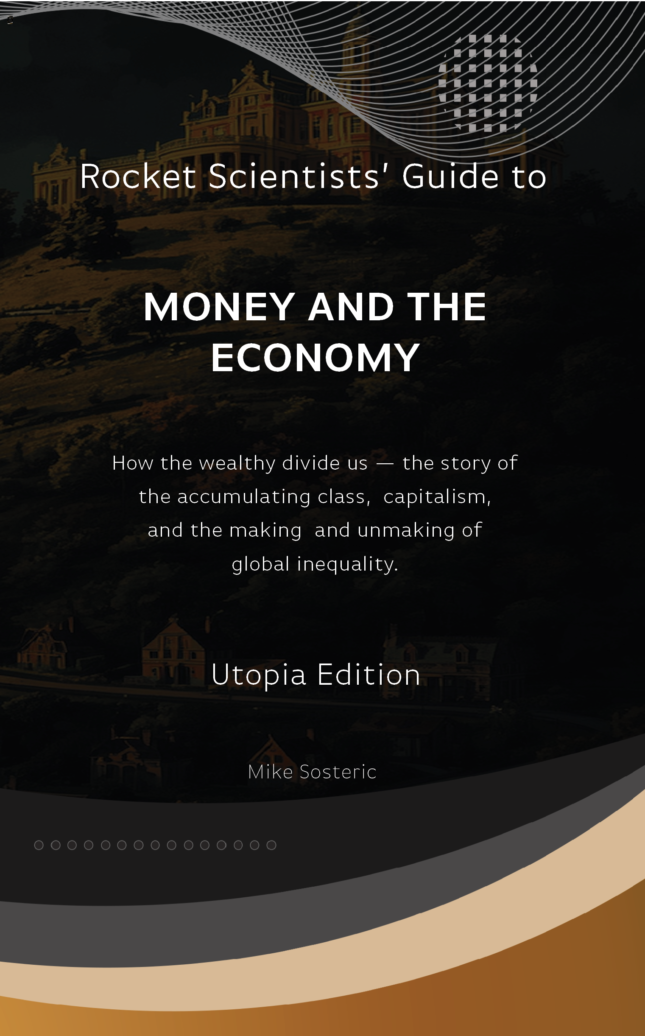
Read all about it in Rocket Scientists’ Guide to Money and the Economy – Utopia Edition, due out Nov 2026.