Welcome to the Peace Table
The Peace Table is a space for people who seek an enlightened conversational space, one concerned with the future of our children and our planet. It is here for those who want grounded, serious, and accessible discussions about Human Potential, Human Development, Healing, Actualization, and the practical work of building Eupyschia—a healed world that works for everyone. If you are working to move past Toxic Socialization and contribute to something better, you are in the right place.
Notifications
Clear all

Sep 20, 2026 10:48 am
Religion. What is it? That's a notoriously tough nut to track. It's so hard that scholars haven't been able to come up with a definition. Some scholars, Max Weber, declined to attempt it at all, saying we should just observe and see what is there.
Observation can be helpful, but religion is a confusing jumble and so it can be hard to understand what exactly you are looking at, or looking for. Thankfully, we don't have to start without guidance. One scholar, Ninian Smart, came up with a seven-part categorization of the elements that any religion might (though not always) contain. The categorization is excellent and comprehensive, but he missed one important element, the healing/therepeutic element, which I add at the end.
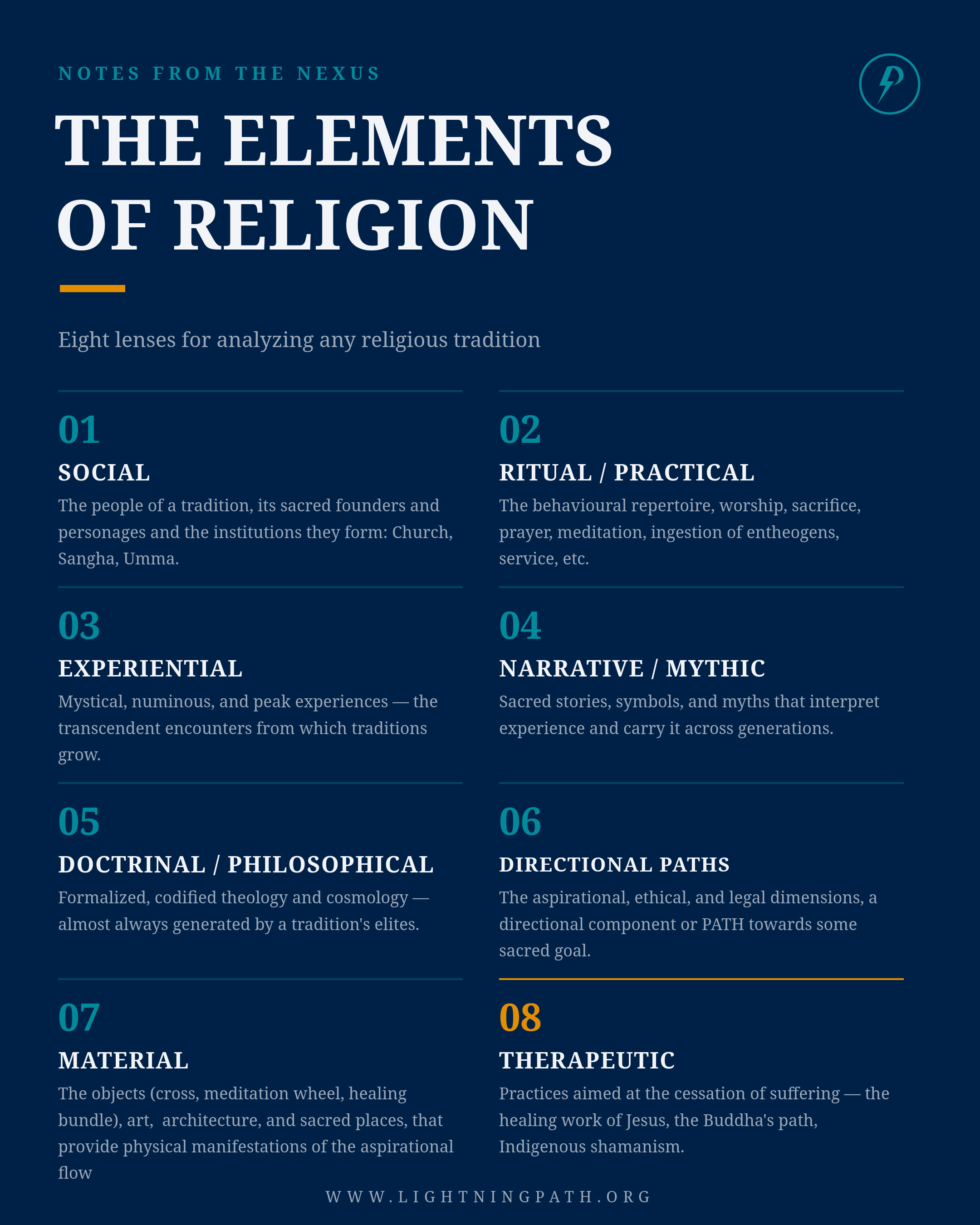
This framework, taken from my book Rocket Scientists' Guide to Religion, offers eight substantive elements which you can use to organize your observations of any institution, religion or not. Use it to help you understand and discuss religion, either in general, or in specific instances, like your own religion, or someone else's.
Feel free to use these elements and post your own observations or comments in this thread.
.
The Eight Elements
1. Social. Every tradition is made of people before it is made of ideas. The social element includes founders, saints, prophets, and personages, as well as the institutions they establish—the Church, the Sangha, the Umma—and the hierarchies, roles, and communities that carry the tradition forward. Examining this element reveals who holds authority, who is included and excluded, and how the group reproduces itself across generations. It reminds the analyst that religion is never merely private; it is always organized life together.
2. Ritual / Practical. Ritual is the tradition's behavioural repertoire: what its people actually do. Worship, sacrifice, prayer, meditation, pilgrimage, fasting, ingestion of entheogens, and acts of service are the repeated practices through which meaning is enacted rather than merely stated. Rituals mark births, deaths, seasons, and transitions, giving abstract beliefs a physical and communal form. To understand a tradition, watch what its adherents do with their bodies, their time, and one another.
3. Experiential. Beneath every tradition lie experiences—mystical, numinous, ecstatic, or peak moments—that the tradition grows out of and points back to. These are the transcendent encounters, conversions, visions, and awakenings that individuals report and communities cherish as evidence of the sacred. The experiential element explains why religions begin: someone experiences something that demands explanation and response. It also explains persistence, since rituals, stories, and doctrines are ultimately technologies for cultivating or recalling such experience.
4. Narrative / Mythic. Traditions interpret experience and transmit it through sacred stories, symbols, and myths. These narratives—creation accounts, hero journeys, liberation stories—do not need to be historically literal to be functionally true; they carry meaning, identity, and values across generations. Myth provides the shared vocabulary through which members understand their lives and their world. An institution's stories are often its most durable property, outlasting its doctrines and its buildings.
5. Doctrinal / Philosophical. Over time, a tradition's experiences and stories are formalized into codified theology, philosophy, and cosmology. This is the intellectual architecture—the systematic statements about what is real, what is ultimate, and how things hang together. Because systematization requires education and leisure, doctrine is almost always generated by a tradition's elites: priests, theologians, philosophers, and scholars. Analyzing this element shows what a tradition officially claims to be true and where its internal tensions and debates are managed.
6. Directional Paths. Aspirational / Ethical / Legal. Every tradition contains a map and a pointer: an account of where human beings ought to go and how to get there. This element encompasses moral codes, ideals of the good person and the good society, and the religious laws that encode them—Sharia, halakha, dharma, or what this framework calls The Path. It moves a tradition from description to demand, telling adherents not just what is real but how to live in light of it. Institutions reveal their deepest values here, in what they praise, what they prohibit, and what they forgive.
7. Material. Traditions make themselves visible in the physical world through objects, art, architecture, and sacred places. The cross, the meditation wheel, the healing bundle, the cathedral, the mandala, the mosque—the these material forms give the aspirational flow a tangible body. Sacred geography and sacred objects anchor identity, focus devotion, and make the tradition present in daily life. The material element reminds analysts that institutions are also built environments and crafted things, not only texts and teachings.
8. Therapeutic (the +1). The final element, added to Smart's original seven, names practices aimed at the cessation of suffering. Healing is a central promise of many traditions: the healing work of Jesus, the Buddha's path as a cure for dukkha, Indigenous shamanic restoration of balance. This element highlights that institutions do not only explain the world or regulate behaviour—they also claim to repair persons and communities. Where an institution's healing function fails or is abandoned, its credibility and cohesion often fail with it.
Taken together, the eight elements form a diagnostic checklist: an institution can be profiled by asking what it experiences, practices, narrates, teaches, demands, builds, organizes, and heals. No single element is sufficient on its own, and the relative weight of each reveals a tradition's character. A framework like this keeps analysis balanced, preventing the common error of mistaking one element—usually doctrine or ritual—for the whole.
View the full size graphic by visiting its link