
Welcome to the Peace Table
The Peace Table is a space for people who seek an enlightened conversational space, one concerned with the future of our children and our planet. It is here for those who want grounded, serious, and accessible discussions about Human Potential, Human Development, Healing, Actualization, and the practical work of building Eupyschia—a healed world that works for everyone. If you are working to move past Toxic Socialization and contribute to something better, you are in the right place.

This forum is for discussion of Erich Fromm's "To Have or to Be." The book is interesting from an LP perspective because it argues that there are two ways to exist in the world, to Modes of Being, an inauthentic one that leads to psychopathology and world system failure, a.k.a. Debacle and an authentic one that leads to needs satisfaction, growth, connection, and joy. Basically the difference between being real and being fake. We'll use this thread for questions, research, and discussions of this important ide
Download from the LP Repository or Internet Archive
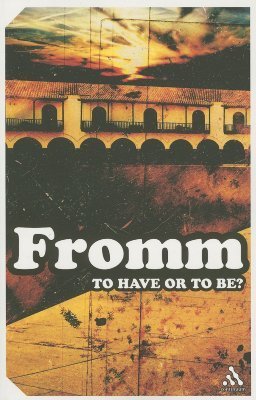
This morning I examined Chapter Four of the book. There Fromm makes some interesting statements about having-mode and its consequences. he says that in having mode
- we are biased, we see everything through a filter of ownership, property, increase of property, exploitation
- we emphasize consumption, not preservation, throw out the old, in with the new
- we treat ideas like property,
- that existence is deadness "In the having mode, there is no alive relationship between me and what I have. It and I have become things, and I have it, because I have the force to make it mine. But there is also a reverse relationship: it has me, because my sense of identity, i.e., of sanity, rests upon my having it (and as many things as possible). The having mode of existence is not established by an alive, productive process between subject and object; it makes things of both object and subject. The relationship is one of deadness, not aliveness." (p. 77-8).
- that we seek power over others.
- that society seeks to break our natural "tendency to grow in terms of their own nature..." (p. 78). This involves restriction of our "free, spontaneous expression...[our] third for knowledge and truth, their wish for affection." (basically suppressing our drives to fulfill our needs). Undermining needs satisfaction and the drives which impel us to satisfy them causes rebellion, neurosis, psychosis, pathology,
- having-mode implies power over others. to increase our "having," we must control others (employees, slaves, etc.)
- suppression of needs and drives leads to a fruitless rebellion. Rebellious energies are sublimated (music, the sexual gaze, food, circuses, alcohol, etc.). Rebellion fruitless unless grounded in
- English language expresses ownership
- Note in the chapter Fromm distinguishes Toxic Having from Existential Having - this is 'having' that is required for existence, food, shelter, clothing, tools necessary to fulfill needs.Having food, shelters, clothing etc. are existential and not in conflict with being.
Chapter Five - What is Being Mode
In this chapter Fromm elaborates more on his "Being-Mode" of existence.
- Being mode is experienced
- the "living human" cannot be described, only its persona (the mask) -> i don't buy this
- prerequisites for being-mode is independence, freedom, critical reason, being active "not in the sense of outward activity, of busyness, but of inner activity, the productive use of our human powers" (p. 88)
- give up the "crutch of property"
To be active means to give expression to one’s faculties, talents, to the wealth of human gifts with which—though in varying degrees—every human being
is endowed. It means to renew oneself, to grow, to flow out, to love, to transcend the prison of one’s isolated ego, to be
interested, to “list,” to give. (p. 88)
This is really a chapter on alignment and connection as central to healthy existence.
Fromm makes a distinction between alienated activity and non-alienated activity.
Alienated activity is activity that is (in LP terms, not aligned and not arising from connection). Fromm Uses the example of post-hypnotic suggestion to illustrate, the person is acting but not doing "what they want to do." Also illustrated with adaptations like "OCD", person being driven by unconscious motives, not doing what they want
Nonalienated activity is different: " I experience myself as the subject of my activity. Nonalienated activity is a process of giving birth to something, of producing something and remaining related to what I produce. This also implies that my activity is a manifestation of my powers, that I and my activity and the result of my activity are one. I call this nonalienated activity productive activity." (p. 91)
Productive Activity: basically, activity that arises as a consequence of your connection to spiritual ego, your alignment with your true self. "Productive activity denotes the state of inner activity....Productive persons....give birth tot heir own faculties and bring life to other persons and to things." (p. 92)
The difference between "mere busyness" and productive activity.
Being as reality: From also distinguishes between being and appearing. In the former, words and behaviour are in alignment with character, spiritual ego, inner self, human nature, in the latter we put on a face, act and exist in the interests of another.
"My behavior may partly reflect my being, but it is usually a mask that I have and that I wear for my own purposes. " (p. 97)
Fromm suggests traditional psychoanalysis as a way to uncover the things that have been repressed, I would say, as a consequence of Toxic Socialization[sw]</p>
<p>Fromm suggests the "normal" socially adapted citizen is a toxic blend of false information, biases, irrational passions, prejudices (p. 98). To that I would add maladaptive adaptations as well.</p>
<p>For Fromm, the normal person is not real, not authentic, not a "being," but sickness, passively existing as an unaligned and disconnected cog in the system. From notes that we try to "organize" this jumble in a way that makes sense, but it makes no sense. It's a "false map" that obscures the fact that "What is repressed in the knowledge of reality, the knowledge of what is true....If we ask,l then: <em>What is unconscious?</em>the answer must be: Aside from irrational passions, almost the whole of knowledge of reality." (p. 98). We repress reality because we are afraid of it, because awareness of it "dangerous."</p>
<p>Examples,</p>
<ul>
<li>suppressing awareness of a partner's sexual abuse of children because to acknowledge it might lead to assault/abuse, complications with the law, the collapse of life as it is.</li>
<li>suppressing awareness of your abusive parents and their behaviours because you need their love or support</li>
<li>suppressing the awareness of climate change and its consequences because you want to travel and consume, and acknowledging it would make that travel and consumption guilt-ridden</li>
</ul>
<p>From notes that we all have an innate capacity, a really well developed one at that, to perceive reality. It's not something we have to work on. It is something we have to recover</p>
<p>Fromm spends a lot of time discussing needs here, specifically our need to be good, to sacrifice, to be helpful. He points out that we all have this need and gives numerous examples from history and contemporary society where people are happiest when they are giving and not just receiving. </p>
<p>On the LP we place this series of needs in the [sw]Alignment Needs category, since these needs represent the spiritual ego's desire to have an aligned vessel to operate.
It is clear to me at this point that being-mode is synonymous with an individual who is living in an aligned and connected state. Such an individual would share some basic characteristics with other aligned and connected individuals (loving, compassionate, aware, will full, authentic, real, etc.) but would bring their own experiences and idiosyncrasies to their character.